
Can You Quit Drugs Without Rehab? Understanding When Professional Treatment Is Needed
Seasons Rehab Bangalore
A Guide to Drug Addiction, Recovery and How Seasons Rehab Bangalore Can Help
When someone realises that drugs are affecting their health, relationships, career or future, one of the first questions they may ask is:
“Can I quit drugs on my own, or do I need rehab?”
The answer is different for everyone.
Some people may be able to stop using drugs with support from a doctor, therapist, family or recovery group. Others may need a structured rehabilitation programme because addiction has become difficult to control, withdrawal may be risky, or repeated attempts to quit have not lasted.
The important thing is not to see rehab as a punishment or a sign of weakness. Professional treatment is a form of support that can make recovery safer, more structured and more sustainable.
Drug addiction is a complex health condition that can change the brain’s reward and motivation systems, making it difficult for some people to stop despite genuinely wanting to quit. Effective treatment can help people recover and rebuild their lives.
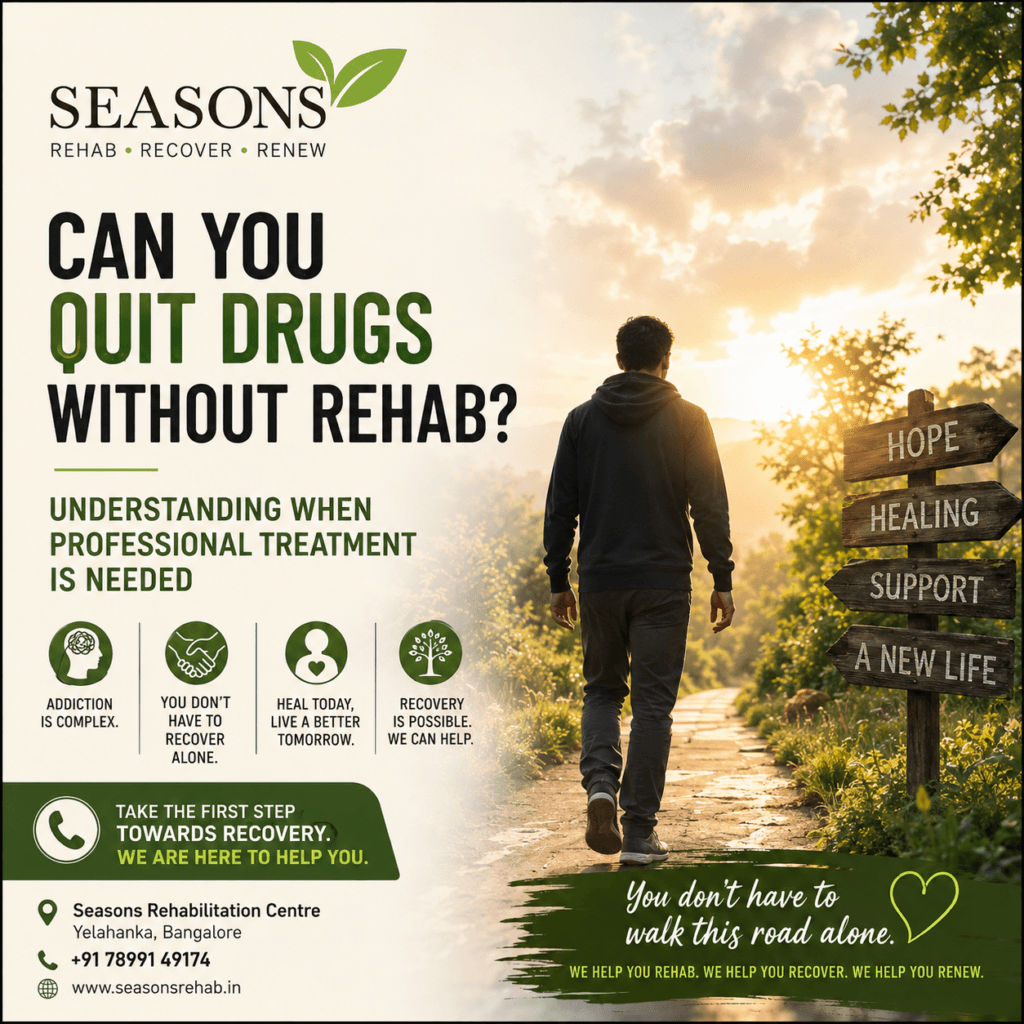
Can You Really Quit Drugs Without Rehab?
Yes, some people can recover without residential rehab, particularly when their substance use is less severe and they have appropriate professional, family or community support.
Treatment does not have to look the same for everyone. Depending on a person’s needs, care may involve outpatient counselling, behavioural therapy, medication where appropriate, peer-support programmes, or more intensive residential treatment.
However, trying to quit completely on your own can become difficult when drug use is frequent, cravings are intense, withdrawal symptoms occur, or previous attempts have resulted in relapse.
The real question is therefore not:
“Do I need rehab because I use drugs?”
It is:
“What level of professional support do I need to recover safely and stay in recovery?”
Signs That You May Need Professional Treatment
Consider seeking an addiction professional if you recognise several of these signs:
1. You Have Tried to Quit Before
You may genuinely want to stop but find yourself returning to drugs after a few days or weeks.
Repeated relapse does not mean you are weak. Addiction can be difficult to manage without appropriate treatment and continuing support.
2. You Cannot Control Your Drug Use
You may tell yourself that you will use only a small amount but end up taking more than planned.
Difficulty cutting down or controlling use is an important warning sign that professional assessment may be appropriate.
3. Drugs Are Affecting Your Daily Life
Professional help becomes particularly important when substance use starts affecting:
- Work or studies
- Family relationships
- Finances
- Physical health
- Mental health
- Friendships
- Responsibilities at home
- Legal or social situations
When obtaining or using drugs becomes more important than normal responsibilities, it may be time to seek help.
4. You Experience Strong Cravings
If you spend a significant amount of time thinking about when, where or how you will use drugs, stopping can become increasingly difficult.
Treatment can teach strategies for managing cravings, identifying triggers and developing healthier responses to stressful situations.
5. You Experience Withdrawal
Some substances can produce significant withdrawal symptoms when use is reduced or stopped.
Depending on the substance, withdrawal can include physical and psychological symptoms and, in some circumstances, can require medical supervision.
Do not assume that stopping suddenly is always safe. If you have been using drugs regularly or heavily, speak with a qualified healthcare professional about the safest way to stop.
Why “Cold Turkey” Isn’t Always the Best Plan
It can be tempting to throw away the drugs, stay home for a few days and promise yourself that you will never use again.
For some people, this may be the beginning of recovery. But simply stopping the substance does not necessarily address the reasons behind the addiction.
Addiction can involve:
Cravings + Triggers + Emotional Issues + Habits + Environment + Relationships + Mental Health
If these underlying factors remain unaddressed, the risk of returning to drug use may remain.
That is why effective treatment often combines different forms of support rather than relying on willpower alone. Behavioural therapies can help people understand patterns of use, develop coping skills, manage cravings and reduce relapse risk.



What Happens in Rehab?
A good rehabilitation programme is much more than simply keeping someone away from drugs.
Treatment can include several stages.
Assessment
The first step is understanding the person’s drug use, physical health, mental health, family situation, history of previous treatment and recovery goals.
This helps determine what type and intensity of treatment may be appropriate.
Detoxification and Withdrawal Support
For people who require detoxification, professional support can help manage withdrawal and monitor the person’s condition.
Seasons Rehab Bangalore describes a detoxification process tailored according to the individual’s circumstances and the substance involved.
Therapy and Counselling
Stopping drug use is only one part of recovery.
Therapy can help individuals understand:
- Why they started using drugs
- What triggers their cravings
- How they respond to stress
- How addiction has affected their relationships
- How to manage difficult emotions
- How to prevent relapse
Relapse Prevention
Recovery does not end when someone leaves rehab.
A strong recovery plan should prepare individuals for situations where cravings, stress, social pressure or old environments may tempt them to use again.
Learning how to recognise triggers and respond differently can become an important part of long-term recovery.
How Seasons Rehab Bangalore Can Help
Seasons Rehabilitation Centre in Bangalore provides residential addiction treatment programmes designed around individual recovery needs. The centre is located in Yelahanka, Bangalore.
Seasons describes its approach as a bespoke integrative recovery programme, with confidential support and treatment tailored to the individual.
Our Treatment Approach Includes:
12-Step Philosophy & Group Work
A structured recovery approach that encourages personal responsibility, support and connection with others in recovery.
Cognitive Behavioural Therapy (CBT)
Helps individuals identify unhealthy thought and behaviour patterns and develop healthier ways of responding.
Psychotherapy
Provides an opportunity to explore emotional and psychological factors connected with addiction.
One-to-One Therapy
Individual sessions can focus on personal circumstances and underlying issues.
Interpersonal Group Therapy
Group-based support can help individuals develop communication and relationship skills while connecting with others who understand addiction.
Addiction Workshops
Educational sessions can help residents understand addiction, recovery and relapse.
Relapse Prevention
Residents learn strategies to recognise triggers and prepare for challenges after treatment.
Yoga and Wellbeing Activities
Seasons also includes yoga, team-building activities and other therapeutic approaches as part of its recovery programme.
Recovery Doesn’t End When Rehab Ends
One of the biggest concerns people have is:
“What happens when I go home?”
Returning to everyday life can bring back old triggers, relationships, routines and pressures.
Seasons states that its programme includes support with reintegration into society, ongoing support and family assistance following residential treatment.
This continuing support can be important because recovery is a long-term process rather than a single event.
What If You’re Not Sure You Need Rehab?
You don’t have to make the decision alone.
If you are questioning your drug use, speaking with an addiction professional can help you understand your situation and determine what level of support may be appropriate.
You may not need residential rehab.
You may need outpatient treatment.
You may benefit from counselling and recovery support.
Or you may need a structured residential programme.
The right treatment depends on the individual. Evidence-based addiction care is not “one size fits all”; treatment should be matched to the person’s needs and adjusted as those needs change.
A Message to Families
If you are reading this because someone you love is using drugs, remember that addiction is not simply a matter of having poor willpower.
Arguments, threats and criticism may not solve the underlying problem.
Instead, encourage your loved one to speak with a qualified professional and learn about the available treatment options.
Families can play an important role in encouraging someone to enter treatment and remain connected to recovery.
You Don’t Have to Wait for Rock Bottom
You don’t have to lose your job.
You don’t have to lose your family.
You don’t have to experience a medical emergency.
You don’t have to wait until addiction completely takes over your life before asking for help.
If you have tried to quit and cannot, professional support may be the next step.
At Seasons Rehab Bangalore, the focus is not simply on stopping drug use. The programme aims to help individuals understand their addiction, address underlying issues, develop recovery skills and build a healthier life beyond addiction.
Take the First Step Towards Recovery
Rise and Shine – Seasons Rehab – India, Bangalore