
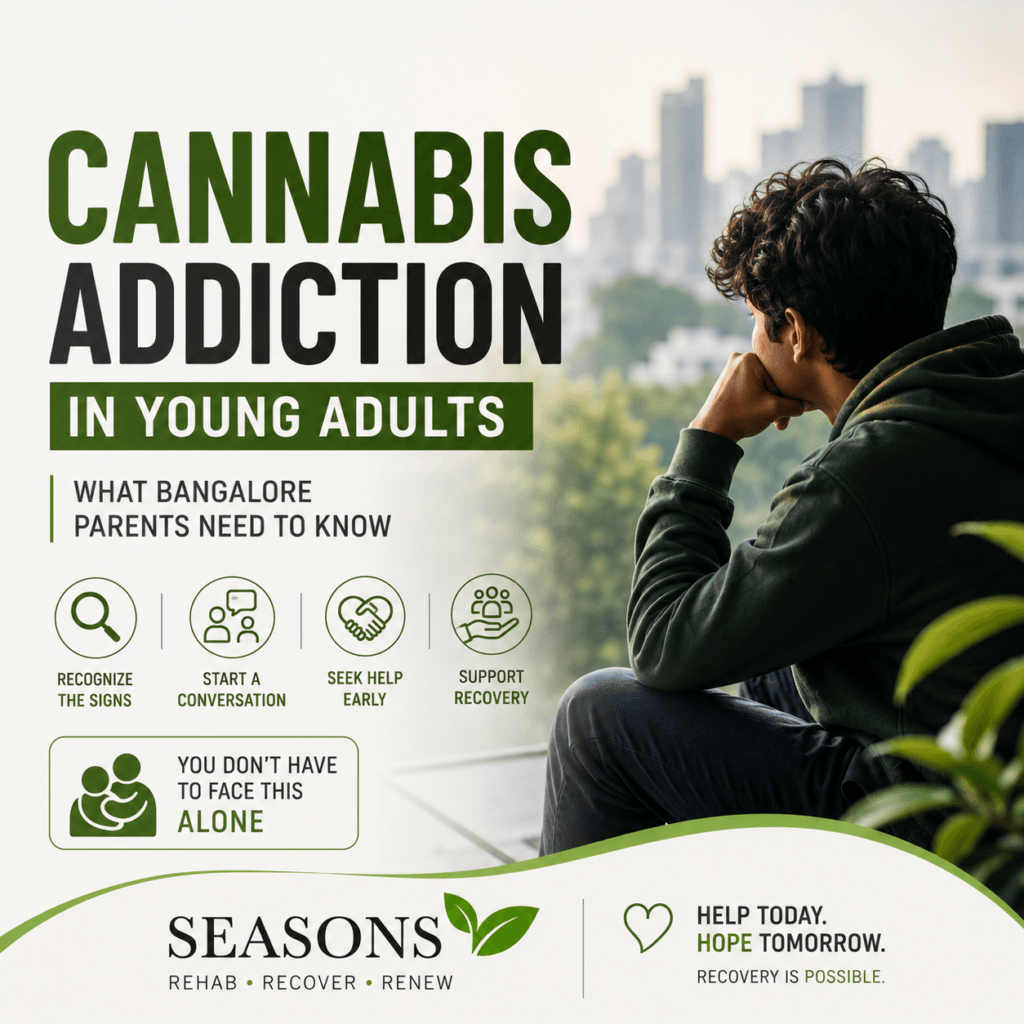
Cannabis Addiction in Young Adults: What Bangalore Parents Need to Know
Understanding the warning signs, risks and treatment options — and how Seasons Rehab Bangalore can help
For many Bangalore parents, the word cannabis may initially sound less concerning than substances such as heroin, cocaine or methamphetamine. Young adults may describe cannabis as “just weed,” “natural,” or something that helps them relax and socialise.
But cannabis use can become problematic, particularly when it begins at a young age or becomes frequent.
Cannabis Use Disorder (CUD) occurs when a person finds it difficult to control cannabis use despite experiencing problems because of it. The risk is higher among people who begin using cannabis during adolescence or youth and those who use it more frequently.
For parents, the challenge is often recognising when occasional experimentation has crossed the line into a pattern requiring professional help.
Why Should Bangalore Parents Be Concerned About Cannabis?
Bangalore is a city where young adults are exposed to a fast-paced combination of college life, technology, nightlife, social media, work pressure and changing social environments.
Cannabis may become part of a young person’s social circle or coping strategy.
A young adult might say:
“Everyone I know uses it.”
“It’s not addictive.”
“I can stop whenever I want.”
“It helps me sleep.”
“It’s only cannabis.”
The problem isn’t simply whether a person has used cannabis. The important question is whether cannabis is beginning to control their behaviour, priorities and daily life.
Cannabis affects areas of the brain involved in memory, attention, learning, decision-making, coordination and emotions. Regular or heavy use during adolescence and young adulthood can be particularly concerning because brain development continues into the mid-20s
When Does Cannabis Use Become Addiction?
Not everyone who uses cannabis develops an addiction.
However, there are warning signs that parents should take seriously.
A young adult may be developing Cannabis Use Disorder if they:
- Use more cannabis than they intended
- Try to stop but repeatedly return to using
- Experience strong cravings
- Spend considerable time obtaining, using or recovering from cannabis
- Lose interest in hobbies or activities
- Neglect college, work or responsibilities
- Continue using despite family or relationship problems
- Need increasingly larger amounts to achieve the desired effect
- Use cannabis in risky situations, such as before driving
- Continue using despite physical or psychological problems
- Experience symptoms when they stop using cannabis
One of the biggest warning signs is loss of control.
Signs Parents May Notice at Home
Cannabis addiction isn’t always obvious.
Sometimes the changes are gradual.
Parents may notice:
Changes in behaviour
A previously responsible young adult may become secretive, withdrawn, irritable or less interested in family activities.
Changes in education or career
There may be:
- Falling grades
- Missed classes
- Poor concentration
- Absenteeism
- Reduced motivation
- Declining work performance
Changes in friendships
Their social circle may change significantly, particularly if most of their activities begin revolving around substance use.
Changes in sleep and routine
They may stay awake late, sleep excessively or develop an irregular daily routine.
Financial changes
Unexpected requests for money, unexplained spending or borrowing money repeatedly can sometimes be warning signs.
Emotional changes
Parents may observe increased anxiety, irritability, mood changes or withdrawal from family life.
These signs do not automatically prove cannabis addiction. They can have many causes. But when several occur alongside regular cannabis use, a professional assessment may be worthwhile


“He/She Is Still Functioning” — Is That a Reason Not to Worry?
Not necessarily.
Some young adults continue attending college, going to work and socialising while their cannabis use is becoming problematic.
This can make addiction difficult for families to recognise.
A person may appear to be functioning normally while privately experiencing cravings, increasing tolerance, failed attempts to quit or psychological dependence.
Functioning is not the same as being healthy.
If cannabis is increasingly necessary for relaxation, sleep, socialising or coping with emotions, it deserves attention.
Can Cannabis Affect Mental Health?
Cannabis can affect mental functioning and has been associated with mental-health risks. The association with psychosis and schizophrenia is stronger among people who begin using earlier and use more frequently.
This does not mean cannabis causes every mental-health problem, nor that every cannabis user will develop one.
However, parents should take symptoms such as severe paranoia, hallucinations, extreme confusion, unusual behaviour or significant changes in mood or functioning seriously and seek urgent professional assessment when they occur.
Cannabis use and mental-health conditions can also occur together, making a proper assessment particularly important.
Why Do Young Adults Start Using Cannabis?
There isn’t one reason.
Common motivations can include:
- Curiosity
- Peer pressure
- Social acceptance
- Experimentation
- Stress
- Academic pressure
- Workplace pressure
- Anxiety or emotional difficulties
- Desire to relax
- Coping with difficult experiences
- Believing cannabis is harmless
The reason someone started using cannabis may be very different from the reason they continue using it.
For example, what begins as experimentation may eventually become a way of coping with stress.
That’s why effective treatment needs to look beyond the substance itself.
What Should Parents Do If They Suspect Cannabis Addiction?
The first reaction is often fear or anger.
Parents may want to immediately confront their son or daughter, search their belongings or threaten them with consequences.
Although understandable, confrontation alone may not address the underlying problem.
Instead, try to:
1. Choose the right moment
Have the conversation when the person is sober and relatively calm.
2. Avoid accusations
Instead of saying:
“You are destroying your life.”
Try:
“I’ve noticed some changes recently, and I’m worried about you. Can we talk?”
3. Listen
Give the young adult an opportunity to explain what they are experiencing.
4. Ask open questions
For example:
- “How often are you using cannabis?”
- “Do you feel you need it?”
- “Have you tried stopping?”
- “What happens when you don’t use it?”
- “Is something causing you stress?”
5. Encourage professional assessment
A qualified addiction professional can help determine whether the person is experiencing problematic cannabis use and what level of treatment may be appropriate.
Open, judgement-free communication and early treatment are encouraged in guidance for families dealing with youth substance use.
Does Cannabis Addiction Require Rehab?
Not necessarily. Treatment should be based on the individual’s needs.
Some people may benefit from outpatient counselling or therapy. Others may require a more structured residential programme, particularly when cannabis use is severe, there are repeated failed attempts to stop, significant family or occupational problems, co-occurring mental-health concerns, or a difficult home environment.
Substance-use treatment can include counselling, behavioural therapies, medication where clinically appropriate for particular conditions, peer support and rehabilitation. There is no single treatment approach that works for everyone.
The first step is therefore professional assessment, rather than assuming that every person needs the same treatment.
How Seasons Rehab Bangalore Can Help
Seasons Rehabilitation Centre, Bangalore, provides residential addiction treatment programmes designed around individual needs. Seasons is located in Yelahanka, Bangalore, and offers confidential professional support and 24-hour assistance.
For a young adult struggling with cannabis or other substance use, Seasons can provide a structured environment away from everyday triggers and routines.
The rehabilitation programme includes approaches such as:
Individualised Treatment
Every person’s addiction journey is different. Treatment can be planned around the individual’s substance use, emotional wellbeing, family circumstances and recovery needs.
Therapy and Counselling
Therapeutic support can help individuals understand the thoughts, emotions, situations and behaviours connected with substance use.
Cognitive Behavioural Therapy
CBT can help identify unhealthy thought patterns and develop healthier ways of dealing with cravings, stress and difficult emotions.
One-to-One Therapy
Individual sessions provide a private environment to explore personal challenges and underlying issues.
Group Work
Group-based recovery work can help young adults understand that they are not alone and develop healthier interpersonal and communication skills.
Relapse Prevention
Recovery doesn’t simply mean stopping cannabis.
It also means learning how to handle:
Cravings → Triggers → Stress → Peer Pressure → Emotional Difficulties → High-Risk Situations
without returning to substance use.
Family Support
Addiction affects the entire family.
Helping parents and family members understand addiction can make communication and long-term recovery more constructive.
Seasons describes its rehabilitation approach as including personalised care, therapy, group work, relapse prevention and aftercare support.
Recovery Is About More Than Stopping Cannabis
A young person may be able to stop using cannabis for a few days or weeks.
The bigger challenge can be learning how to live without needing it.
That may involve:
- Building healthy routines
- Developing coping skills
- Improving emotional regulation
- Rebuilding relationships
- Returning to education or work
- Developing healthier friendships
- Learning to manage stress
- Finding meaningful activities
- Preparing for triggers and relapse
The goal is not simply:
“Don’t use cannabis.”
The goal is:
“Build a life where you no longer need cannabis to cope with life.”
When Should Parents Seek Professional Help?
Consider speaking with an addiction professional if your young adult:
- Cannot stop despite wanting to
- Uses cannabis frequently
- Has repeatedly relapsed
- Has significant cravings
- Is neglecting college or work
- Has experienced major relationship problems because of cannabis
- Has developed significant behavioural or emotional changes
- Uses cannabis alongside other drugs or alcohol
- Has experienced paranoia, hallucinations or other serious psychological symptoms
- Is increasingly isolated from family and normal activities
Early intervention can prevent a developing problem from becoming more deeply established
A Message to Bangalore Parents
If your son or daughter is using cannabis, don’t immediately label them as an addict.
And don’t ignore the problem either.
Look at the bigger picture.
Ask yourself:
Is cannabis affecting their health?
Their studies or career?
Their relationships?
Their motivation?
Their mental wellbeing?
Their ability to control their use?
If the answer is yes, it may be time to seek professional guidance.
You don’t have to wait for a crisis.
You don’t have to wait for your child to lose everything.
Early support can make a difference.
Take the First Step Towards Recovery with Seasons Rehab Bangalore
At Seasons Rehab Bangalore, we understand that addiction affects more than the person using the substance. It affects families, relationships, education, careers and the individual’s sense of self.
Our focus is to provide a structured, confidential and supportive environment where individuals can understand their addiction, work on underlying issues and develop skills for long-term recovery.
Take the First Step Towards Recovery
Rise and Shine – Seasons Rehab – India, Bangalore